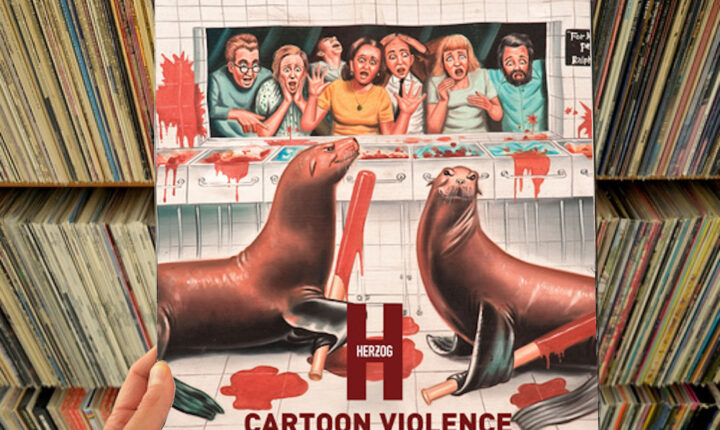
A deeper look at the grooves pressed into the Cartoon Violence LP by Herzog. Did it take me an unreasonably long time to review Herzog’s Cartoon Violence LP? Yes, yes it did [the album was originally released in 2012, and it is projected that this review copy arrived at Ground Control‘s office in 2017 –ed] – and the reason for that is simple: Cartoon Violence exists as a series of contrasting elements which are all trying to function and/or co-exist at the same time, and the sum of its parts completely defies simple critical assembly or deconstruction. The album features cover art which depicts two sea lions smirking darkly in a “You’re next” kind of way, while holding baseball bats which are covered in blood – in a room with blood sprayed on the walls being observed by vacationers looking on in mute horror. The image was rendered in a manner which looks a lot like the covers of old copies of MAD Magazine, or like album covers by bands like NOFX, Dead Milkmen, RKL or M.O.D. in the Eighties – but that potential visual precedent is completely overturned as soon as the record starts playing; listeners notice that the song’s title is, “Fuck This Year,” but what erupts from stereo speakers sounds like a sped-up version of Sixties pop.
Simply said, Cartoon Violence doesn’t seem to know what it wants to be from note one – and that status does not change for the album’s entire runtime.
After “Fuck This Year” seems to start the album’s movement down one particular path, that direction immediately arcs a hard left onto a different one as soon as “Rock and Roll Monster” follows, and in no way lives up to its name. There, after a solid guitar build-up, the song doesn’t peak or plateau, it just moves along at a sort of subdued trot which sort of crosses the pop songwriting chops of The Monkees with the non-threatening plastic energy of New Wave (you know what I mean – the kind of plasticity that made it sound good when Blondie delivered lines like, “Once I had a love, and it was a gas” with none of that song’s original reggae underpinnings). Simply said, the song’s potential is perfectly self-evident – and that it is not realized in the slightest is absolutely infuriating – the song just shuffles along and flashes lines like “Rock and roll will make you a monster,” but doesn’t show any of the teeth that such a lyric would need to make a believer out of anyone and, when it finally sputters to a close, no one who hears the song will be left with an elevated energy level or feeling ready for a greater experience, “Rock and Roll Monster” just leaves as flat as a pancake.
After the first two cuts plateau at the same level on which they started, listeners will likely not be feeling like Cartoon Violence is going to amount to very much – but “You Clean Up Nice” begins to show signs of life which resemble redemptive. There, lean but overdriven guitars contrast against the stiff and rigid vocal delivery that the band has chosen to call part of their style, and while lines like, “She used to look at me like I was going to steal her car/ She fell in love, got hitched and I saw her at the bar/ Don’t tell me I clean up nice, you know that is wrong” are pretty elementary within the context of punk and indie rock, they’re solid enough to not be completely forgettable. That might come off as damning with faint praise, but when you’re looking for something to like within a fairly lean form, the right ears and mind will take what they can find and run with them. Thinking in those terms will make the more Seventies-inspired prog-pop of “Rich People Ballad” feel like a pretty meaty cut, as will the folkier turn that “Dreaming Man II” takes to close out the side – but by then, listeners will realize that they have only heard a series of songs which don’t feel like they have a connective thread between them and, like any mixtape, listeners won’t feel as though they’ve been served something that has whetted their appetites at all; Side A was about as filling as a Twinkie.
Side B plays in roughly the same manner. When needle catches groove and “Feedback” opens the side, rattling synths and a quasi Brit-Pop-informed vocal begin and create still another musical inroad for the album to fill. For the three-and-a-half-minute duration of the song’s running, it works; the minor chords which power “Feedback” perpetuate a lonely and almost winsome emotional drive, and lines like, “This is where I belong/ The singer told me in a song/ Try my best to make you feel welcomed/ but you know I can’t be blamed/ When you call him by my name” echo the sorrow of the minor chords while adding just the right amount of scorn. It’s an excellent way to start the movement of a new side, and “Your Son Is Not A Soldier” holds that focus very well when it follows up, but the side’s quality is sealed in perfectly when “Shakespearean Actress” establishes a song structure reminiscent of the greatest moments in the Eels’ songbook. There, Herzog battles against its own natural compulsions and slows its movements down as well as lightening its touch, and the result is the moment that both the album and listeners needed; lines like, “That’s me ringing the door with a bottle in my pocket/ That’s you on the couch – a green dress, a silver locket/Legs crossed and your feet are bare/ Hair twisted to one red braid down your neck and around the front/ To where my eyes have strayed” effortlessly paint the picture of a doomed romance nearly identical to the sort that Mark Oliver Everett built half of his career upon.
“Shakespearean Actress” is, very simply, the kind of cut that listeners of a particular mind can inhabit and love. It’s so good, in fact, that it stands alone, completely unlike everything else on Cartoon Violence feels permissible for a moment – until “Alexander The Great” enters the running to close out the album’s running, flaunting another musical form at its foundation which is completely unlike everything else on the album. This time, AT THE ALBUM’S CLOSE, Herzog dusts off a mechanical-but-dance-y structure not unlike that which Franz Ferdinand introduced itself in 2003. To be perfectly fair, the form fits Herzog really well; the clunky and mathy but still danceable form manages to roll along as fluidly as the character’s gender in the song (check out lines like, “He needed money for college, so I told him to enlist/ My face was wet with pride when I gave him a goodbye kiss”i – granted, there is mention of a mother in the song too, but the intimacy doesn’t feel shared in that manner), and it feels as though a different kind of energy has begun to manifest by song’s end – but then the needle lifts and there is nothing new to find. For those who have run front-to-back with the album, how the B-side ends is simply infuriating.
When one takes Cartoon Violence as a whole, it’s impossible to not be angered by the album and, unfortunately, there is no relief for that sentiment to be found. Herzog tries so many different things on this album, and some of them are definitely worthwhile – but the victories are left abandoned every time another song starts and the band tries on another sound like a different pair of shoes. Of course, Cartoon Violence was released in 2012 and the band released other albums after this, but the band never left Exit Stencil Records and the label’s status is questionable [Exit Stencil’s website remains partially online, but is only partially functional –ed] – so the verdict on what might come next from the band is still very much out. Even so – as difficult to follow as Cartoon Violence is – it’s hard not to hope the band reappears again; on this album alone, there are enough open possibilities to keep listeners hopeful, indefinitely. [Bill Adams]
Artist:
https://www.exitstencil.org
https://www.facebook.com/herzogsounds
https://www.instagram.com/herxog
Listen:
Herzog – Cartoon Violence LP – [Stream]
Album:
Herzog’s Cartoon Violence LP is out now. Buy it here on Amazon.