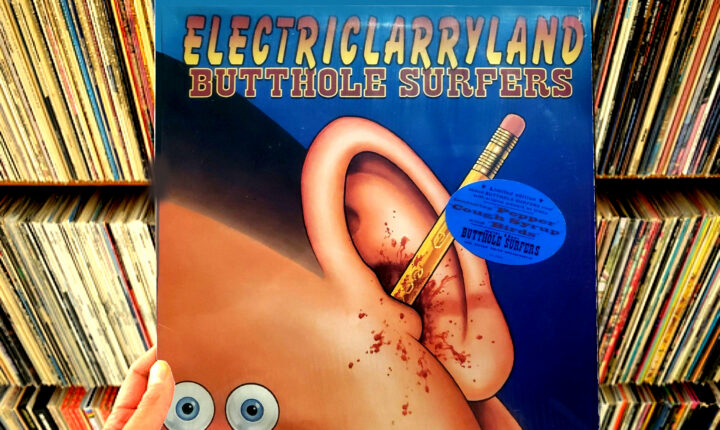
Butthole Surfers – “Thermador” – Electriclarryland 2LP
A deeper look at the grooves pressed into Butthole Surfers’ Electriclarryland 2LP. Only in the Butthole Surfers’ world could the band’s greatest commercial success also mark the beginning of their collapse. By the time they began making their seventh album, the Surfers were finally beginning to see some of the increased interest that they had worked so hard to generate; they had already made an album with a member of Led Zeppelin producing (1993’s Independent Worm Saloon was produced by John Paul Jones), had already built solid working relationships with a who’s who of both punk and rock royalty (including Jello Biafra, Mark Kramer and Al Jourgensen) and had already made a greater name for themselves on concert stages including that of Lollapalooza (both with their music as well as with singer Gibby Haynes’ accuracy with a shotgun). Having made those inroads was definitely a positive development and, while their record label might have remined unconvinced, work on the album began with Surfers guitarist Paul Leary and Steve Thompson (who’s credits included work with Guns N’ Roses on Appetite For Destruction, production work on …And Justice for All by Metallica and work on John Lennon’s posthumous album Milk and Honey, among many others) as producers. Upon release, wikipedia claims that the album received mixed reviews from critics [a claim made without the benefit of citation –ed] but, at the time, fans seemed to be on board with the influx of new fans in the audience and the positive reception was very much deserved; as “Birds” opens the A-side, singer Gibby Haynes cackles out an intro that is equal parts confusion (the words, “Alright what’re we doing here,” have never sounded so much like a call to arms as they do here) and blind craziness – but the hook is clean and pulls listeners by being exactly everything even the uninitiated expect; here, the band is playing off the image that they’d been working to make for over a decade and the fury and fervour – the howling tone of Haynes’ voice coupled with the adamantine tone of Paul Leary’s guitar – plays perfectly to that. The results are (for fans) instantly gratifying; the guitars echo back to when John Paul Jones was manning the board on Independent Worm Saloon, but the song itself is just familiar enough to feel a little looser and more dangerous than that, as a result.
After “Birds” ends, the game completely resets as “Cough Syrup” ignores the first direction into which the Butthole Surfers drove – it keeps the sense of urgency which came with “Birds,” but turns the angles and sound on its head. From note one, “Cough Syrup” almost sounds like it wants to march (before King Coffey’s drums enter the mix) as Leary’s guitar sets the song’s tempo with a very rigid rhythm, but it actually softens when Coffey’s drums enter, about eighteen seconds in. When that happens, the Surfers straddle that sense of urgency and a snide punk energy, but there’s also a warmer, almost sad undercurrent which implies that no one will be getting out alive, by song’s end.
…And then, in a haunted and methodical way which plays in excellent contrast to everything the Surfers had done on ANY of their records before it, ”Pepper” asserts its presence. Now with thirty years having since lapsed, it’s difficult to articulate how progressive-in-stance “Pepper” was when it was first released. While bands like The Beastie Boys had already begun creating connective tissue between rock and hip hop, “Pepper” stands on its’ own because it utilizes pop music styling the band had never touched before, and do it so well that it feels like it’s all they’ve ever known; the beat holds listeners tightly as Gibby Haynes begins to unroll a vocal that sounds both fine and confident (lines like, “Marky got with Sharon/ Sharon got Cherese/ She was sharin’ Sharon’s outlook/ On the topic of disease “ only begin to clearly unravel upon close inspection – at a distance, they sound like a bold new evolutionary step for the band) and hooks listeners without even trying, and the best payday comes as the chorus continues to straddle offhanded and profound images, but at no point actually allying with either camp; the band simply lets the chorus exist for listeners, and then moves on inconsequentially, revelling in other strangeness like reversed vocals and looped samples which only prove to actually interconnect at the end of the song. “Pepper” is (and it feels strange to contend this, in context) a true achievement in the Butthole Surfers’ songbook; it is, arguably, a moment which would foreshadow most of the electronic movements that the band would make throughout the remainder of their songbook to date [see the sounds developed and refined on the Jackofficers’ only studio album as well as on The Weird Revolution and After The Astronaut –ed] but never overtly mimicked.
After “Pepper” both sets and destroys some of the Butthole Surfers’ standards, some listeners may find themselves at least smiling if not flat out laughing as the album continues and just returns on the path it set, initially. “Thermador” recalls the cock rock classicism that the band first started reaching for with John Paul Jones’ help on Independent Worm Saloon – complete with a twisted take on Buffalo Springfield’s “For What It’s Worth” which then descends into tumult with the words, “And ’round, and ’round, and ’round she goes,” to close out the side. While only four songs (and just less than seventeen minutes) deep, the A-side of Electriclarryland is the perfect bait that keeps listeners both engaged and excited as the side ends, and then the B-side recaptures the hardcore blasts of the band’s early career for “Ulcer Breakout.” There, Leary, Coffey and Haynes almost inadvertently explode on one of the greatest and most completely underrated/overlooked meltdowns of their entire career; Leary takes up both guitar and bass duties which ends up adding greater focus to the cut, and Coffey adds excellent, unadorned percussive drive while Haynes presents the greatest, most unadulterated sense of nihilism to the song that any Butthole Surfers cut has ever featured. While the singer was previously content to simply add throwaway lines as placeholders which would add some mania too (see lines like “There’s a time to shit and a time for God/ The last shit that I took was pretty fuckin’ odd” from “The Shah Sleeps In Lee Harvey’s Grave,” or “Goofy’s Concern” – which might just be the most left handed love song in all creation, with its’ “I don’t give a fuck about…” refrain), Haynes sounds like he has found a way to balance something disposable with something utterly profound in lines like, “Ever fall above with a Chevy/ Ever fall above with a Ford/ Ever felt the torque of a hemmi/ Ever seen the face of the lord,” and do it in a way which doesn’t even begin to feel gimmicky. It is, simply said, an excellent cut capable of pulling listeners along through the side very easily – and, while “Jingle Of A Dog’s Collar” and “TV Star” both illustrate a bit of a decline in the side because both the mania and the energy levels lower noticeably, that energy returns in earnest when “My Brother’s Wife” reclaims a sense of paranoia with lyrics that are far more disjointed than its’ predecessors as well as featuring a galloping drum beat which helps to fuel the worry. The energy and fury about “My Brother’s Wife” and B-side closer “Ah Ha” are both excellent, but certainly not at all the same; the manic power of “My Brother’s Wife” is excellent, while “Ah Ha” keeps an energetic pce without falling into anything simple or expected like overdriven guitars of howling vocals; rather, while the movement of the song is energetic, the energy is focused and tempered in that no one flies off the handle or over the edge, the band just powers through and, when the cut crashes to a close, listeners will be ready to switch to the set’s C-side; the music just lines up and expresses that, if you’ve been following along, you know what’s next.
…And, after the peak represented by “Ah Ha” and listeners have had a chance to gleefully swap out the plates and start the C-side of the album, listeners are subjected to a whole other experience, again. First, after needle catches groove, “The Lord Is A Monkey” opens with some formless, molten texture but quickly tightens up to reveal an intoxicating vocal rhythm and a lyric sheet which straddles both a sense of euphoria as well as a sense of menace. Here, lines like, “Thanksgiving’s coming third week of July/ In the form of a girl with a needle in her eye/ Well she came from out west on a nickel worth of gas/ She’s got her mind on her money and her dope up her ass” are simultaneously silly, nonsensical and scary – and the band plays according to Hoyle by sticking with the themes presented as well as the ominous, worrisome and (occasionally) metallic and frightening musical themes expressed. Granted, not everything about the cut is flawless [those who have followed along with the album from front to back will flinch when they hear that, “Well she’s heading back East in a 67 Caddy/ Got her mind on her money and a dope for her daddy” is supposed to mirror the “needle in her eye” line from the previous verse. –ed], but the structure doesn’t fold and listeners will have no difficulty making it into or out of “Let’s Talk About Cars.Now, it could easily be contended that a bunch of Texans including a song on their album which is half sung/narrated in French might just be one of the most transgressive things on Electriclarryland but, practice, it brings a completely different sensation to the proceedings. While Leary has since said that watching the woman speak as the sound was captured for the album bordered on erotic, the fact is that the dialogue coupled with the music in “Let’s Talk About Cars” borders on perfectly captivating, as one listens. Granted, the dialogue is about as confusing for listeners as it was for the non-bandmembers who spoke on the recording (listen to the female voice – even if you don’t speak French, you’ll get the impression that the two people commissioned to speak French aren’t sure how long they should continue speaking or what they should say next), but there is still just “something” about the cut that holds listeners’ collective interest – they might not be sorry to see it go when it ends, but listeners will likely concede that “Let’s Talk About Cars” (which features no lyrics about cars at all, incidentally) is at least time well-wasted.
After “Let’s Talk About Cars” spirals to a close, listeners will be shocked out of their comfort zone when “L.A.” screeches out caustically from note one and never lets up for all of its’ two-minute, forty-second running. Throughout the cut, Haynes howls out a kind of caustic, confrontational and incoherent lyric sheet that is loosely centred on the phrase, “I don’t care,” but no drummer will ever say that King Coffey was incapable of standing on his own in the band [Butthole Surfers featured two drummers playing at the same time until Theresa Nervosa left the band shortly after the release of 1988’s Hairway To Steven –ed], and his performance on “L.A.” proves it – he pushes the cut hard and ensures that the blur is brilliantly contained too.
There’s no question that “L.A.” closes on a deliriously high point that could very easily have ended Electriclarryland in a very solid place but, instead, Butthole Surfers included one last cut which could easily have gone overlooked when it first came out but, with the benefit of hindsight, the band leaves some blueprints behind within “Space” which give an idea of where the band may have been headed – if they had continued on at the time. Right off, strange voices and transmissions appear next to audio of Haynes laughing and very gentle guitar figure, and listeners begin to feel like their ride throug the album is coming to an end – until Coffey’s drums begin to pick up steam about a minute into the song’s running, and the movement becomes increasingly turbulent, as it progresses. More and more along the way, listeners begin to feel like they’re on board for another great adventure as the song’s tempo builds, Leary’s guitar asserts some dynamic presence and Gibbytronics effects emerge but, as soon as listeners brace themselves for the ride, they hear a manic laugh from Haynes and the song clips off. In effect, the Butthole Surfers take one more opportunity to pull the rug out from under listeners again, and then the needle lifts, unexpectedly. On one hand, it’s exactly the sort of prank that fans would expect from the band in theory but, when it actually happens, Listeners who have run front-to-back with Electriclarryland may find themselves shocked at how suddenly the ride’s over. There is one other side in this set which could have featured music, but what interested parties will find on the final side of the original release are a series of etchings which were done by Gibby, and nothing more.
In the thirty years since Electriclarryland‘s release, the legend of the band and this album has grown pretty well. Fans have certainly helped it along – doing their part to help the Butthole Surfers’ legend grow. Because the number of albums that the band released grew a lot shorter after this album came out [There have really only been two Butthole Surfers studio albums to appear since Electriclarryland‘s release in 1996 and, hilariously, After The Astronaut and The Weird Revolution didn’t come out in the order in which they were recorded –ed], every new release has drawn a very excited eye from fans – so when this year saw the release of a new, anniversary edition of Electriclarryland appear on yellow and blue vinyl (one yellow LP, one blue LP) with no etchings on the D-side but a set of cuts culled from singles and soundtracks, a different height of excitement was revived in fans. The “new” songs range from feeling a bit like demos (“Hybrid” doesn’t feel finished) to feeling like genuine misplaced gems (“Whatever” is solid and makes the most of a really good and trip-hoppy beat as well as a guitar part which sounds like it was inspired by a James Bond movie) and “Valuable Charcoal,” which feels like it fell out of the sessions for Independent Worm Saloon, somehow. Granted, it’s very possible that these misplaced songs might not have been appreciated if they’d been tacked on to some other larger release but, in this context, their inclusion is very welcome one.
Standing back and taking this record as a whole, there’s no question about its’ quality; while calling it timeless might sound a little unusual, there’s no way to deny that each of the songs on Electriclarryland play as well now as they did when the record was first released. Those who don’t know should know – if they don’t, they should find out and fix it as soon as possible. [Bill Adams]
Further Reading:
Ground Control Magazine – Butthole Surfers [Discography Review] https://groundcontrolmag.com/butthole-surfers-discography-review/
Ground Control Magazine – Butthole Surfers – self-titled 10” EP – [Review] https://groundcontrolmag.com/vinyl-vlog-702
Artist:
https://www.facebook.com/ButtholeSurfersMusic
https://www.instagram.com/buttholesurfers/?hl=en
https://buttholesurfersmovie.com
https://buttholesurfers.bandcamp.com
Album:
The thirtieth anniversary vinyl reissue of Electriclarryland is out now, limited to 3000 copies. Buy it here, on The Vinyl District. https://www.thevinyldistrict.com/storefront/tvd-radar-butthole-surfers-electriclarryland-30th-anniversary-2lp-reissue-in-stores-8-28/