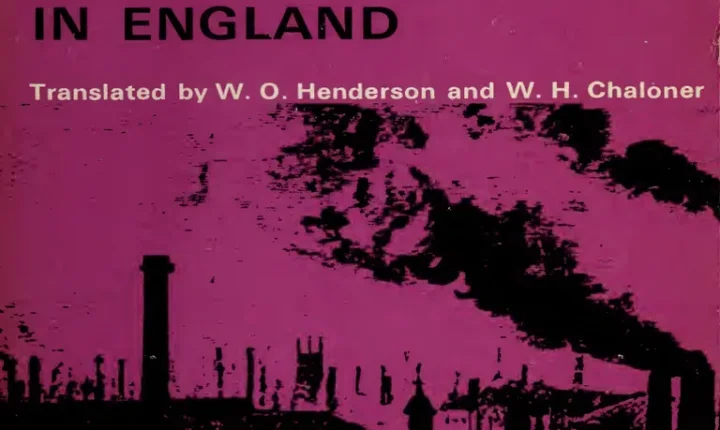
The Condition of the Working Class in England
by Friedrich Engels
Sure, you can call yourself a leftie, but have you actually read the literature? More than just the Communist Manifesto. Have you read Das Kapital? Marx is low hanging fruit. Who’s actually read ENGELS? Well, there’s not much of Engels to read. I guess he spent most of his life defending Marx and finishing volume II and III of Capital which no one read.
But Engels wrote this book before he started working with Marx. Apparently, they met on Engels’ way to England and became collaborators and good friends afterwards.
This copy of The Condition of the Working Class in England is interesting, especially considering the introduction by the translators Henderson and Chaloner. They start off insisting that Engels book is not really considered an accurate or trustworthy representation of what the workers’ conditions were truly like. Then, they basically rake Engels through the coals for having inaccurate references. This ranges from changing the wordage on his quotes, getting dates wrong, missing references, using outdated reports, and using inaccurate numbers. Then they complain about Engels for not going a little easier on the factory bosses who are trying to take measures to improve the conditions in the factory. I get it, that’s all important. So, their effort to accurately translate and check every single reference is truly remarkable and incredibly valuable. Why doesn’t Engels even bother to copy down statements correctly? Come on, guy!
But then you actually read the book and notice these corrections are, for the most part, minor at best: a date is off by a year, a reference was missing but was added, Engels slightly misinterpreted report, or his reference was outdated but still applies or has slightly different calculations. So, yes, this edition is great, but I just don’t see how it makes the majority of this book irrelevant. If anything, this “corrected” version makes it an even more worthwhile book to read.
So, what about the book itself? Well, the working class in England had an absolutely brutal time, it turns out. People are severely overworked, in terrible and unsafe conditions, often suffer from debilitating sickness caused by their jobs, are severely underpaid and live in squalid terrible and filthy conditions. Their diet is unhealthy and their lifestyle is unhealthy. This affects workers of all kinds: men, women, and children. Seriously, the things children (as young as 9) have to go through was horrifying to say the least. It’s all really horrifying, of course. It also argues that due to the Irish, who live on a “lower” standard than the English, that this has caused the English themselves to lower their standards so they can remain competitive in the market. Engels covers professions in textile, coal, and metal. The conditions are shocking and disgusting even if they were HALF as bad as he relates them, so one does wonder what exactly the translators are getting at saying this book is irrelevant. Of course, Engels is going to get all revolutionary on us and say how the workers are being kept in a state of ignorance, how they’re worse than slaves, and that the revolution is going to happen ANY DAY NOW. But, that’s to be expected of him, right?
I assumed it was bad for the workers. This book was written in the 1840s and we all know from Dickens how bad things were, but to put it into perspective on such a massive scale is startling. So, shame on Engels for not being more diligent, yes, but shame also on Henderson and Chaloner for knocking on this book. When I wasn’t disgusted by the subject, I was really enjoying it.